- All proxies are mobile, clean, anonymous, and highly trustworthy.
- Mobile proxies can be used in any software; below you'll find the most popular ones.





Primary (Focus on Authority): Scalable B2B Outreach: Navigating LinkedIn & Quora Algorithm Triggers
- Seo Za
- 6 minutes
The modern B2B landscape is defined by a paradox: we have more tools than ever to reach our ideal customers, yet the "walls" protecting those customers are higher than ever. If you have recently seen your LinkedIn reach plummet or your Quora answers shadowed by a "collapsed" tag, you aren’t just battling a lack of interest. You are triggering immune responses in the platform’s core algorithms.
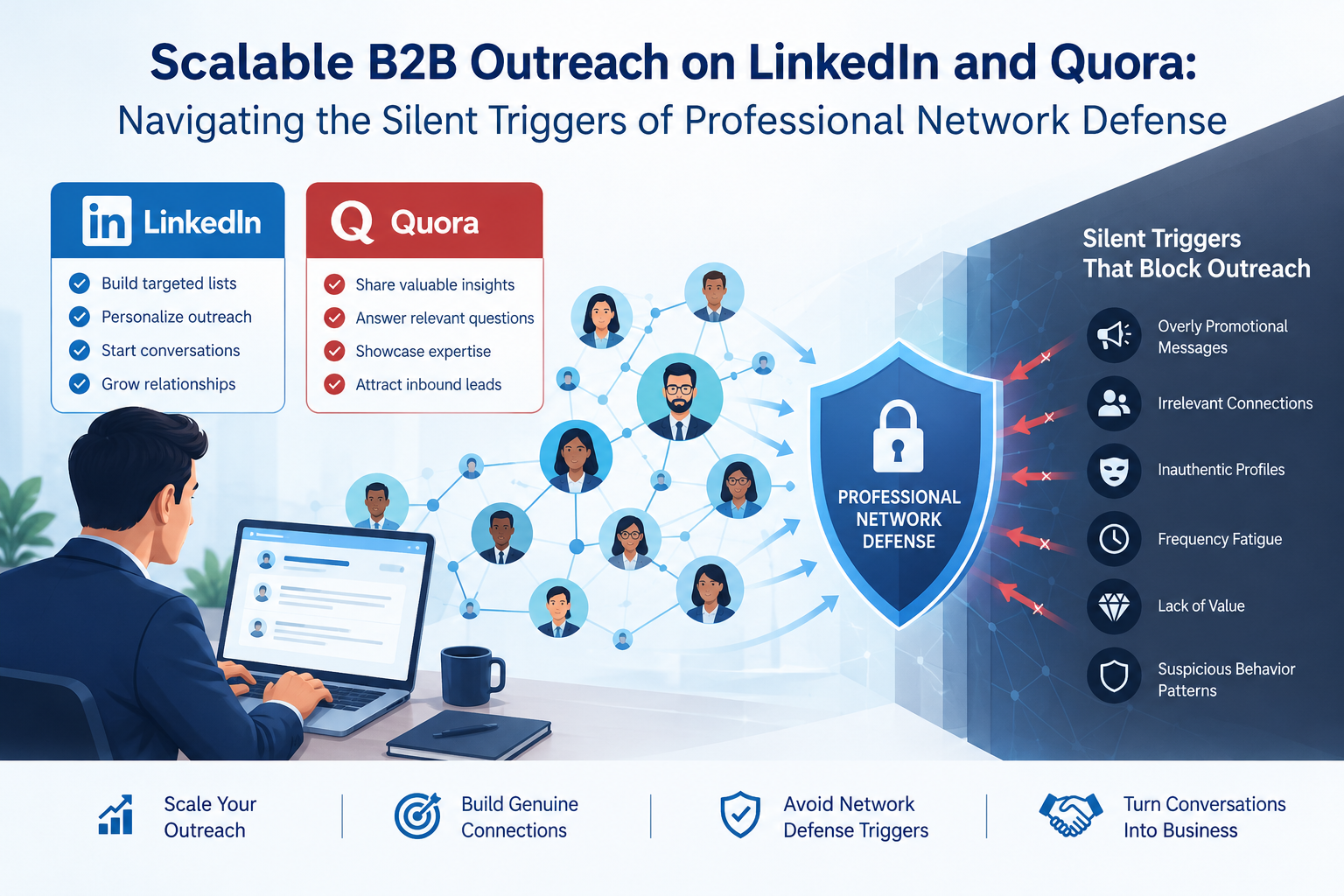
Scaling outreach is no longer about volume; it is about signal-to-noise optimization. When we try to scale, we often inadvertently mimic the behavior of botnets, tripping silent alarms that mark our profiles as "commercial waste."
To grow in 2026 and beyond, we must understand the friction points where human intuition meets algorithmic gatekeeping.
Why Does Your Outreach Trigger a "Soft Ban" Before You Even Start?
Most professionals believe that a ban or a restriction is a binary event—you are either in or out. In reality, LinkedIn and Quora utilize a "probabilistic throttling" system. Before they block you, they diminish you.
The triggers are rarely about what you say, but the velocity and patterns of your presence. On LinkedIn, for instance, the algorithm tracks the ratio of "Outgoing Connection Requests" to "Meaningful Conversations." If you send 50 invites a day and only 2 lead to a back-and-forth exchange, your "Trust Score" drops. The platform assumes you are a generic solicitor, not a networking professional.
On Quora, the trigger is often "Contextual Mismatch." If your account history shows a sudden pivot from answering diverse industry questions to hyper-focusing on a single product-led narrative, the spam filter flags your contributions as promotional content rather than community value.
The "Pattern Break" Framework: How to Scale Without Being Labeled a Bot
To scale effectively, you must implement the Pattern Break Framework. This approach is designed to circumvent the heuristic filters that look for repetitive, automated behavior.
- Variable Velocity: Never send requests or post at the same time every day. Algorithms look for "heartbeat" patterns—actions that happen at precise intervals. Human behavior is messy; your outreach schedule should be too.
- Multimodal Warming: Before sending a B2B pitch, interact with the target's ecosystem. A "like" on a comment they made, followed by a share of a post they were tagged in, creates a "Warm Lead Signal" in the database.
- The 70/20/10 Content Mix: To maintain a high Trust Score, 70% of your activity should be "Nurturing" (commenting on others), 20% "Authority Building" (original insights), and only 10% "Conversion" (direct outreach or CTAs).
How to Master the LinkedIn Algorithm: Beyond the "Connection Request"
LinkedIn's defense mechanisms are now sophisticated enough to read the sentiment of the replies you receive. If people are clicking "I don't know this person" or leaving your requests ignored, you are digging a grave for your profile’s visibility.
The "Social Proximity" Hack
LinkedIn prioritizes "second-degree" connections for a reason: they represent a manageable risk. To scale outreach, don't go wide; go deep into specific "Nodes." Instead of targeting 500 CEOs across the US, target 50 people who all graduated from the same university or worked at the same firm. When the algorithm sees you are gaining traction within a specific "Professional Node," it relaxes the throttling because your presence appears organic to that community.
The "Ghost Writing" Trap
Automation tools often use templates that have been fingerprinted. If 10,000 people are using the same "I saw your profile and was impressed by..." opening line, that string of text becomes a trigger. The Insight: Use "Dynamic Personalization" that pulls from the third or fourth paragraph of their "About" section, not just their job title.
Quora for B2B: Navigating the "Helpfulness" Heuristic
Quora is a different beast. While LinkedIn protects people, Quora protects "The Answer." If your outreach strategy involves answering questions with the intent to drive traffic, you are playing a dangerous game with their "Internal Ranker."
Avoiding the "Commercial Collapse"
Quora’s AI can distinguish between a solution and a sales pitch. If your answer starts with a link, it is almost certainly going to be collapsed. To scale here, you need to use the "Value-First Inversion."
- Provide 90% of the solution in the text.
- Use data-backed evidence (tables, bullet points).
- The "Outreach" happens in the bio or a footnote that offers a "Deep Dive" rather than a "Product Demo."
The Authority Buffer
You cannot scale Quora outreach from a fresh account. You need an "Authority Buffer"—at least 20-30 answers on non-commercial, high-interest topics to establish your account as a "High-Value Contributor." Once this status is achieved, the algorithm is significantly more lenient with external links and brand mentions.
The Scalable Outreach Checklist: A Step-by-Step Guide
If you are ready to transition from manual grinding to intelligent scaling, follow this sequence to keep your accounts safe and your reach high.
- Profile Optimization: Ensure your profile doesn't look like a landing page. Use a human-centric banner, not a corporate logo.
- Low-Frequency Engagement: Spend 15 minutes a day commenting on "Top Voice" posts in your niche. Do not send connection requests yet.
- Bio-Verification: On Quora, link your professional credentials. On LinkedIn, ensure your "Skills" are endorsed by at least 3-5 real colleagues.
- The 5-a-Day Rule: Start with 5 highly personalized connection requests per day.
- Contextual Answering: Find 3 Quora questions with high "Follow" counts but poor-quality answers. Provide the definitive guide.
- The "Double-Touch": If someone views your LinkedIn profile, send a message referencing a specific insight from their recent activity.
- Content Loops: Post an insight on LinkedIn, then answer a Quora question by summarizing that insight and linking back to the LinkedIn discussion. This creates "Cross-Platform Validation."
- Segmentation: Group your targets into buckets of 20. Tailor the "Angle" for each bucket so the messaging never becomes repetitive.
- Monitoring Metrics: If your "Acceptance Rate" drops below 20%, pause all outreach for 48 hours to reset the algorithm's suspicion.
The Infrastructure of Trust: Why Technology Alone is a Trap
We often look for the "perfect tool" to automate our B2B efforts. But the most successful outreach at scale isn't powered by a better script; it’s powered by better data infrastructure.
When you treat these platforms as databases to be mined, the platforms treat you as a miner. When you treat them as environments to be inhabited, the platforms treat you as a citizen. The shift from "Extraction" to "Contribution" is the only way to maintain long-term access to high-value B2B audiences.
Algorithms are designed to catch the lazy. They are designed to filter out those who want the reward of a relationship without the work of a conversation. By respecting the "Natural Growth Curve" of these networks, you don't just avoid triggers—вы build an unshakeable professional reputation.
Final Thoughts: The Human Advantage in an Algorithmic World
In a world saturated with AI-generated outreach and automated sequences, the ultimate competitive advantage is un-automatable nuance.
The algorithms of LinkedIn and Quora are not your enemies; they are your filters. They are cleaning the room so that when you finally speak, you are heard by the right people. Stop trying to "beat" the algorithm. Instead, start feeding it exactly what it wants: high-quality, high-context, and human-centric interaction.