- All proxies are mobile, clean, anonymous, and highly trustworthy.
- Mobile proxies can be used in any software; below you'll find the most popular ones.





What Is Proxy Caching and How Does It Work?
- Yinhao Lee
- 8 minutes
What Is Proxy Caching?
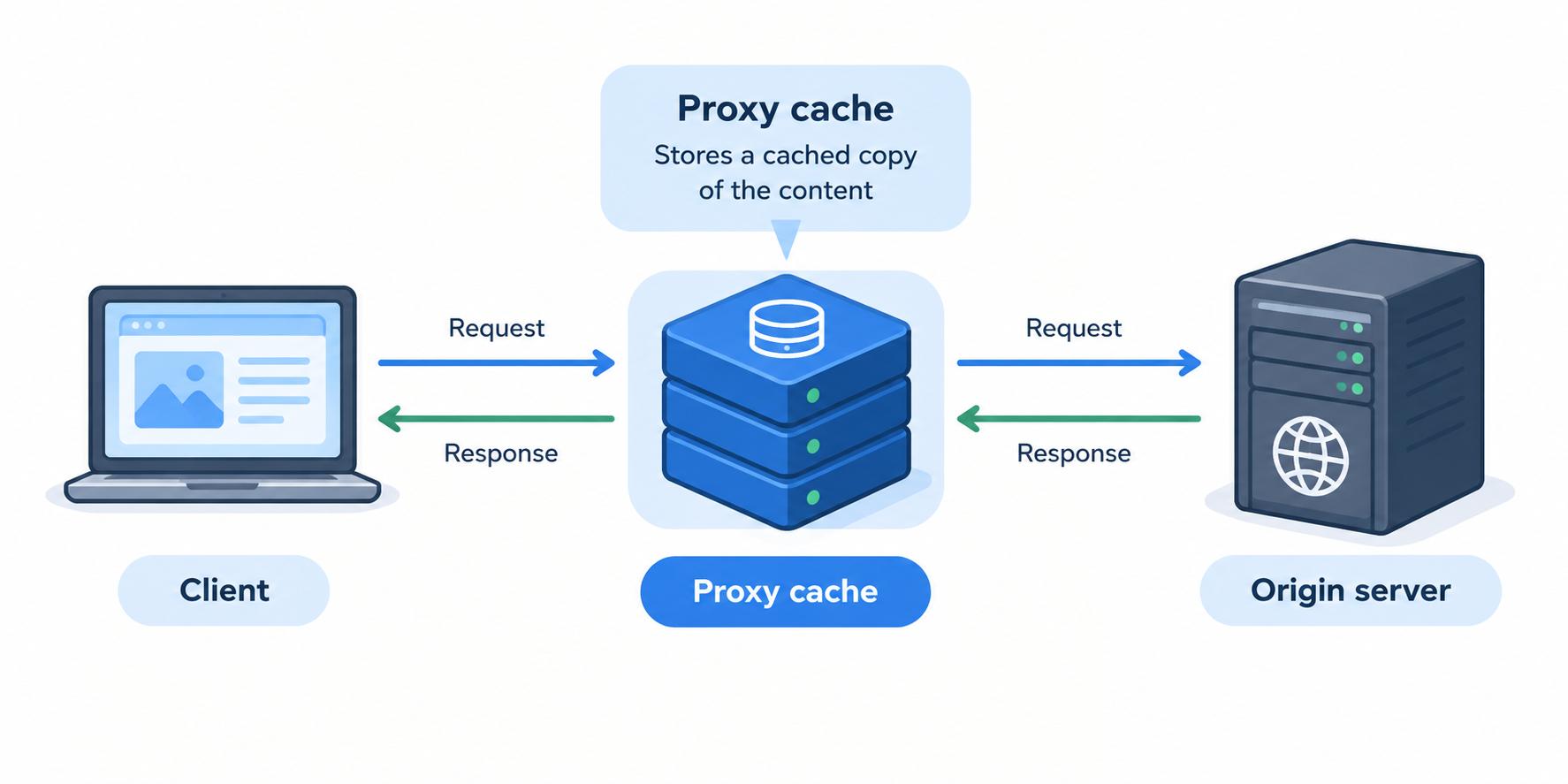
A proxy server stores already-fetched web content and serves it to later requests instead of returning to the origin server.
It keeps a reusable copy close to users. This cuts delay and repeated work.
A proxy cache combines storage with rules that decide what to keep. It controls which objects remain available. Web proxy caching, proxy server caching, and a caching proxy server describe the same setup. The terminology varies. The three parties are the client, this cache, and the origin server. A browser or app sends an HTTP request. The proxy returns a cached copy when it can. Otherwise, it fetches from the origin. Repeat requests become faster because the data travels a shorter network path. Think of a local library branch keeping popular books so you skip delivery from a central archive.
For example, if 200 employees open the same news site and SaaS login page each morning, the proxy fetches shared images, CSS, and scripts once. It then serves those static resources to later visitors from its cache.
How Does Proxy Caching Work?
Proxy caching relies on a proxy cache between clients and the origin server. For each cacheable request, it either serves a stored copy on a cache hit or fetches upstream content on a cache miss. Freshness rules then decide reuse.
The Request Flow: Cache Hit vs. Cache Miss
The request flow begins with a proxy cache lookup. This leads to either a local reply or an upstream fetch.
- The client sends an HTTP GET request.
- The proxy checks the cache index for the URL.
- Cache hit: a fresh object exists, so the node serves it immediately.
- Cache miss: the copy is absent or expired. It may ask neighboring proxy caches or a parent cache first, then contact the origin server.
- If the fetched response is cacheable, a stored copy is kept.
- The answer reaches the requesting client.
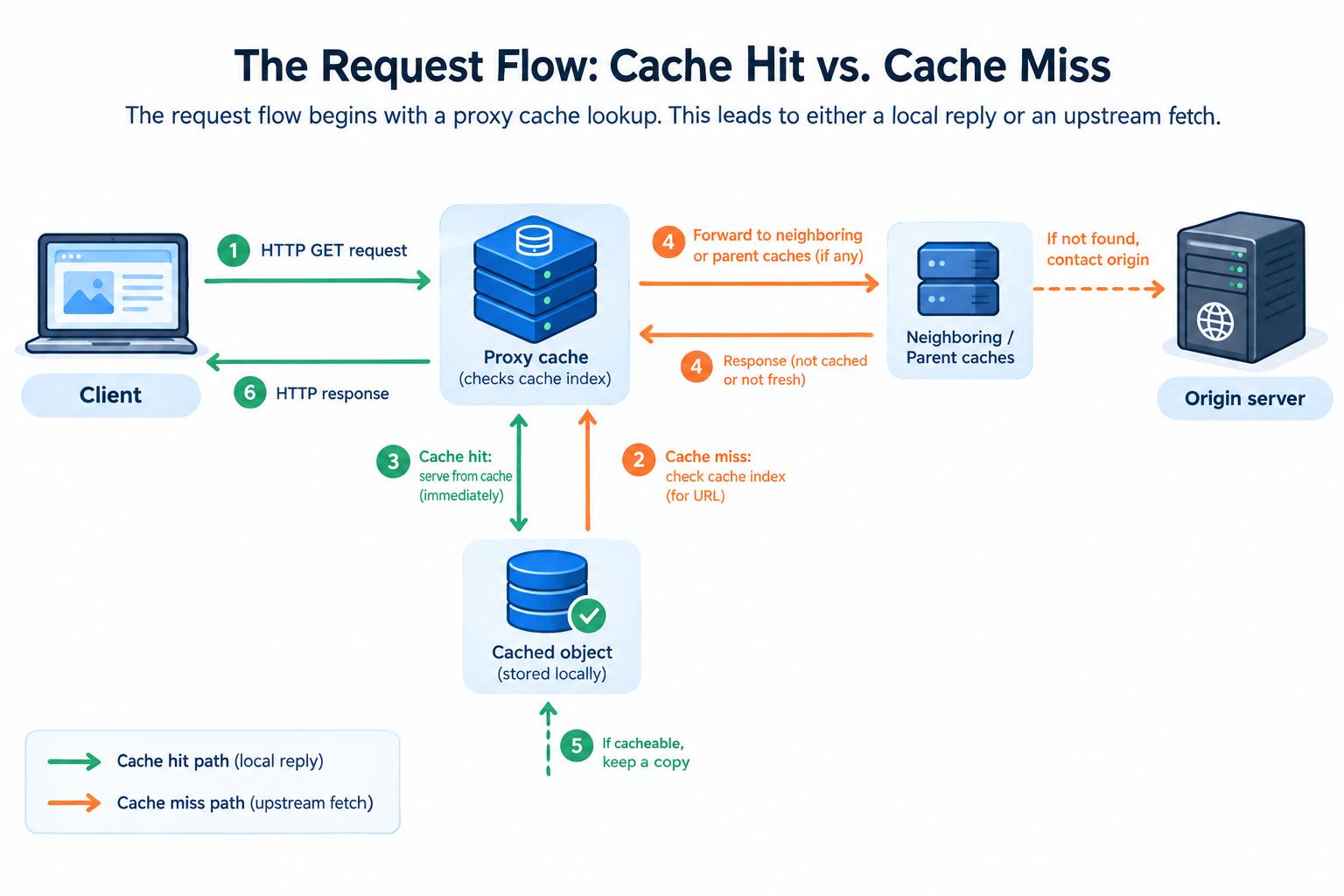
In a hierarchy, siblings or parents can absorb misses before the source is bothered.
A hit avoids the round trip to the origin. The path is shorter, so latency drops for repeat requests. Hit ratio measures the share of requests answered from stored copies. A higher value means less upstream traffic and less work for the backend.
For example, the first employee opens logo.png. That is a miss, so the image is fetched from origin and stored in 300 ms. Seconds later, the second employee requests the same file. That becomes a hit and is served locally in a few milliseconds.
Scenario | What the proxy does | Origin contacted? |
|---|---|---|
Hit | Returns stored content | No |
Miss | Checks helpers, then fetches upstream | Only if helpers lack it |
How the Proxy Decides Whether a Copy Is Still Fresh
The origin server controls freshness with HTTP headers. A proxy cache follows these rules to decide whether a stored copy can be reused.
Cache-Control: public, max-age=3600
This header allows shared caching for one hour.
- Cache-Control sets the main rules, including max-age, no-store, private, and public.
- Expires gives an older absolute expiry time.
- Last-Modified records when the resource last changed.
- ETag identifies a version so the origin can confirm changes.
After expiry, the proxy can send a conditional request. If nothing changed, the origin answers 304 Not Modified. The proxy keeps the body and avoids a full download. When headers are missing, the cache may estimate a TTL heuristically. Administrators can also tune local rules.
For example, a product image with max-age=86400 can be served all day. A stock-price response with max-age=5 is refreshed almost every request. The trade-off is direct. A longer freshness window raises the hit ratio. It also raises the risk of stale content. Short values keep data current but increase origin checks and latency.
What a Proxy Cache Stores (and What It Never Stores)
Web proxy caching works best with stable, shared resources. It usually stores static content: images, CSS, JavaScript, fonts, downloadable files, video segments, and public pages.
Content type | Typically cached? | Why |
|---|---|---|
Images, CSS, JavaScript | Yes | They rarely change and many clients request the same files. |
POST or PUT responses | Rarely | They usually change state or reflect one action. |
Personalized or authenticated pages | No | They may expose one user’s data to another. |
HTTPS CONNECT tunnel | No | The proxy cannot read or cache encrypted traffic without TLS interception, which raises privacy and security issues. |
A shared proxy does not cache a logged-in banking dashboard. It can still cache the bank’s logo and stylesheet. Responses marked no-store or private stay out of the shared store. Personalized data, unique dynamic content, and many query string URLs are excluded unless the origin allows reuse. Proxies may also perform DNS caching.
Types of Proxy Caches
A proxy cache sits close to users or servers. In web proxy caching, placement decides who benefits. It also shapes what gets protected.
Type | Where it sits | Who uses it | Main advantage |
|---|---|---|---|
Forward proxy cache | Near clients | Company, school, or ISP users | Speeds repeated browsing and cuts shared bandwidth costs |
Reverse proxy cache | In front of origin servers | Public visitors to a site | Shields the origin and speeds delivery under load |
Transparent proxy cache | Inline on the network | Networks that want no client setup | Requires no client configuration or manual setup |
Non-transparent proxy cache | Explicitly configured in apps or the OS | Managed networks with policy control | Gives admins clear routing, filtering, and policy control |
Distributed cache or hierarchical cache | Across parent, child, or sibling groups | Large networks or ISPs | Raises hit rates across cooperating locations and tiers |
CDN edge cache | Global edge locations | Worldwide site audiences | Brings content closer to visitors worldwide |
In practice, choose forward caches near clients for shared browsing and reverse caches near origins for faster site delivery. A CDN edge layer scales this pattern globally. For example, a university can pair a non-transparent forward proxy cache for campus browsing with a reverse proxy cache for its public enrollment spikes.
Benefits of Proxy Caching
The benefits of proxy caching appear when repeat traffic is high enough to keep the cache busy. Actual gains depend on the hit ratio and the share of content that can safely be stored.
- Lower latency: A stored copy skips the trip to the origin. This improves page speed and the user experience on repeat visits.
- Reduced bandwidth: The proxy avoids repeated downloads of the same files. That cuts transfer volume and can reduce network costs. This matters most on metered links.
- Less origin server load: The backend answers fewer identical requests. This leaves capacity for dynamic work and can delay hardware upgrades.
- Better scalability and availability: Caches absorb traffic spikes instead of passing every request onward. They can also serve stored content during short origin outages. For many sites, proxy caching turns such bursts into routine load.
- Indirect SEO and conversion gains: Faster delivery can help page speed signals. It may also increase completions, although the effect is indirect and hard to isolate.
- Added control and privacy: Reverse proxies hide backend details from clients. Forward variants can also enforce filtering and usage policies. This simplifies audits.
With proxy caching, a small online shop may reach a 70% hit ratio on product pages during a flash sale. The origin then handles only about 30% of requests, so it stays responsive at checkout under peak load.
Limitations and Risks of Proxy Caching
Ignoring cache rules turns a helpful shared proxy cache into a source of wrong answers. The usual motive is faster delivery, but the price can be private data leaking, stale pages, and painful invalidation. Cleanup often costs more than the original speed gain.
Cache-Control: private is missing, one visitor may see someone else's account name.- Stale content from long freshness timesUse correct
Cache-Controland short TTLs for volatile items. - Dynamic or personalized content served to the wrong visitorSet the
Varyheader and mark private responses correctly. - Cache poisoning or leaked private dataApply access control, avoid caching logins, and use purge tools.
- Hard cache invalidation and limited HTTPS visibilityTest purge rules and use TLS between cache and origin.
Common Proxy Caching Software and How to Check It Works
Proxy server caching is implemented by several open-source packages. Header names vary, but the verification method is similar.
- Squid: classic forward caching server
- Varnish Cache: HTTP accelerator for reverse caching
- Nginx: reverse gateway with optional caching
- Apache Traffic Server: high-traffic caching gateway
Verification uses two requests for the same image with curl -I. Comparing response times shows the difference. The first response often shows a miss. The second can show a hit and an Age header value.
Age: 120X-Cache: HIT
A missing age can mean the object was fetched and stored only a moment ago. The Via header and hit ratio in access logs or stats give further confirmation.
Proxy Caching FAQ
Is a proxy cache the same as a browser cache?
No. A browser cache is private to one user and device. A proxy cache is a shared cache that can serve many clients from the same stored copies.
Is proxy caching the same as a CDN?
Not exactly. A CDN is a large, managed network of caching reverse proxies. It places copies near visitors worldwide, while a single proxy cache usually serves one network or site.
Can a proxy cache HTTPS content?
Only if it performs TLS termination. A reverse proxy or managed interception setup can decrypt, cache, and re-encrypt. A plain HTTPS tunnel is opaque, so traffic passes through unread.
Conclusion: When Proxy Caching Makes Sense
- Proxy caching keeps reusable copies close to users, making repeat requests faster, cheaper, and easier on origin servers.
- A proxy cache pays off when hit ratio is high, freshness rules are correct, and private content is excluded.
- Use a forward cache for many network clients and a reverse cache to protect and accelerate your site.
For example, a team may use a reverse cache for static assets and a mobile proxy to check pages from a carrier network. OnlineProxy mobile proxies run on real 4G/5G carrier IPs through modems and SIM routers with real SIM cards. They support HTTP or SOCKS5 with username and password authentication.