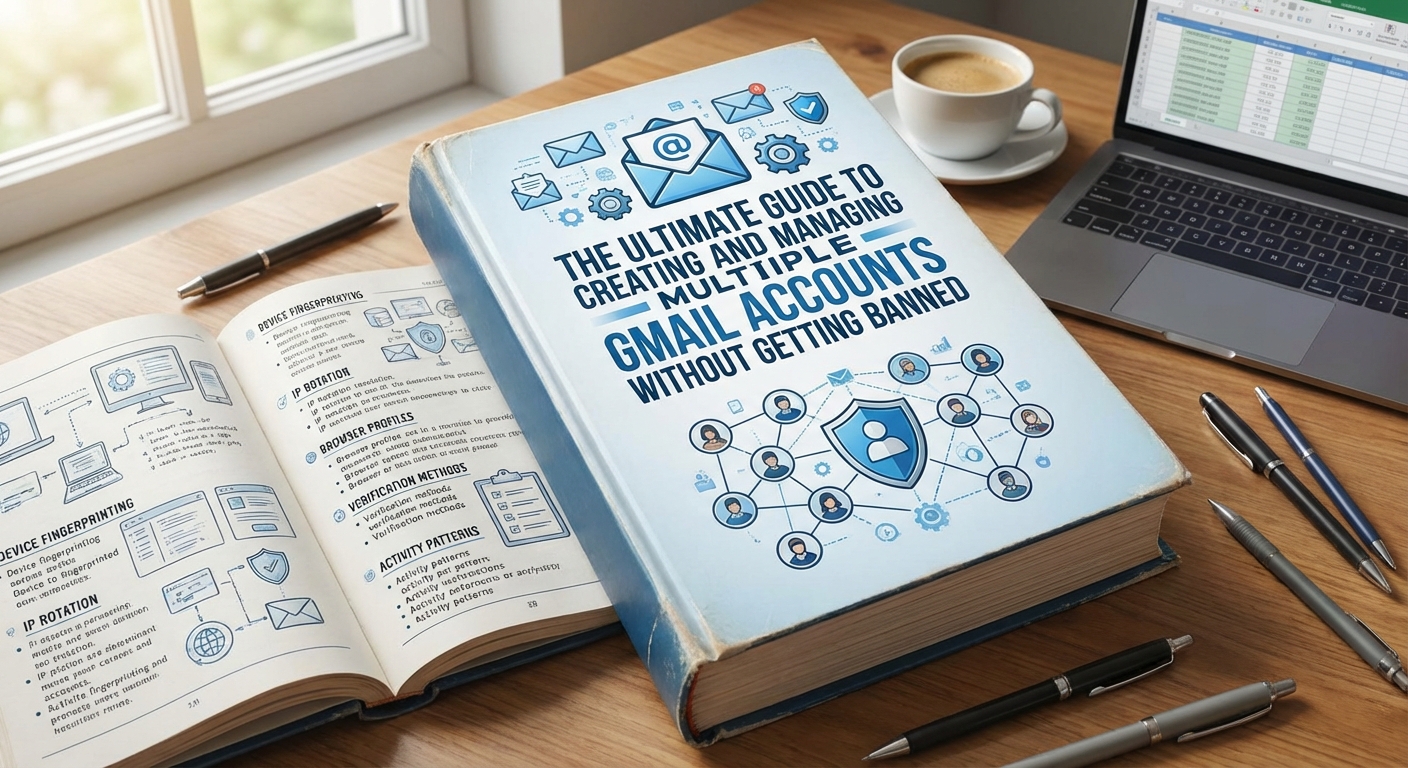
Every year, thousands of digital marketers, developers, and privacy-conscious users face the disruption of a sudden Gmail account suspension. With 32% experiencing at least one such incident annually, the cost in lost campaigns, halted development, and compromised data is staggering. But what if you could safely operate multiple Gmail accounts, each isolated and ban-resistant? This ultimate guide distills cutting-edge strategies for creating and managing multiple Gmail accounts without triggering Google's automated systems. From understanding Google's hidden restrictions to leveraging anti-detect browsers for large-scale operations, we provide a step-by-step blueprint for digital professionals who need reliable, separate inboxes.
A recent study found that 32% of digital marketers and developers have experienced at least one unexpected Google account suspension in the past year. This isn't just an inconvenience—for businesses, it can mean abruptly halted ad campaigns, locked developer tools, and lost revenue. Understanding the legitimate need for multiple accounts, and the severe risks of mismanaging them, is the first step to protecting your operations.
The Cost of Error: A Chain Reaction of Suspensions
The most common and costly mistake is treating multiple Gmail accounts as independent entities while managing them from a single device, IP address, or browser fingerprint. The motivation is simple: convenience and cost-saving. Why log in and out when you can stay logged into all accounts?
The Mistake: Using a single workstation or residential IP to create, log into, and actively use dozens of “separate” Gmail accounts.
The Motivation: It’s efficient and avoids the perceived hassle of secure, isolated management.
The Impact: Google’s automated systems don’t just look at individual account activity. They build a holistic graph of ownership. When your single IP suddenly births five new accounts, all of which begin logging into the same third-party ad platform within minutes, the system flags a pattern. The “suspension domino effect” begins:
1. First Strike: One account is flagged for “suspicious creation” and suspended.
2. Forensic Linkage: Google’s algorithms analyze the suspension. They note the identical IP, browser fingerprint, and potentially even phone verification patterns.
3. Mass Action: All other accounts associated with that same “graph” are retroactively suspended for “connected policy violations,” often without individual warnings. A marketer doesn’t just lose one ad account; they lose all agency accounts, their personal account for recovery, and any Google services tied to them. The financial price includes frozen ad budgets (often pre-paid), halted campaign revenue, and days of manual recovery appeals.
Devil's Advocate: "But I Use Them for Completely Different Things"
A fair counter-argument is: “If I use Account A for client X’s ads and Account B for my personal newsletter, they’re truly separate. Google can’t prove they’re the same person.”
This has limited validity in isolation, but it collapses under operational reality. The linkage isn’t just about *what* you do with an account; it’s about the *digital archaeology* of *how* you access it. Google’s systems are probabilistic. They don’t need absolute proof; they need a risk score that crosses a threshold. Logging into Account A and Account B from the same unproxied AWS instance, with the same timezone and typing cadence, creates an undeniable correlation that outweighs any difference in usage patterns for automated enforcement.
The main thesis holds: for anyone needing multiple Gmail accounts for business operations, the risk of a Gmail account ban is not a matter of *if* but *when*, unless deliberate isolation strategies are employed. This guide’s purpose is to define those strategies—the specific technical and procedural walls you must build—to ensure your accounts remain functionally separate in Google’s eyes, turning a 'why use multiple gmail' idea into a sustainable operational asset.
- Marketing Teams: Running separate ad campaigns for different clients or product lines without cross-contamination.
- Developers & QA: Testing app integrations, API limits, or new features in isolated sandbox environments.
- Professionals & Freelancers: Keeping client communications distinct from personal emails.
- Privacy-Conscious Users: Separating social media sign-ups, newsletters, and financial accounts from a primary identity.
- Business Owners: Managing distinct brand inboxes while retaining a personal account.
Understanding these severe outcomes leads us to the core question: how does Google detect and punish linked accounts? The answer lies in its multi-layered restriction system.
Google enforces strict, multi-layered limits on Gmail account creation and usage to combat spam and fraud. These restrictions are not arbitrary; they are automated, data-driven defenses. Understanding the specific technical mechanisms is critical for anyone operating multiple accounts.
Consider a typical scenario: an agency attempts to create 20 Gmail accounts for client campaigns from one office IP. This exceeds Gmail's account limits—specifically the per-IP creation threshold of 5-10 accounts per 24 hours—and triggers Google's anti-fraud protocols. Within hours, all 20 accounts are suspended for "suspicious activity." The financial impact for a mid-sized agency can exceed $10,000 in lost ad spend and recovery costs. The why gmail blocks accounts in such cases is systemic risk prevention: better to block a false positive than allow a spam network.
Common Red Flags That Trigger Google's Systems:
These gmail account limits and ip restrictions form a cohesive anti-abuse framework. While frustrating for legitimate users, they are essential to Gmail's integrity. The lesson is clear: any strategy involving multiple accounts must first engineer around these technical barriers, or face the consequences of a gmail account ban.
Restriction | How It Works | Impact |
|---|
Phone Number Verification | Hard cap: ~4-5 accounts per verified number. | Blocks mass creation; forces acquisition of multiple numbers. |
IP Address Reputation | IPs creating >5-10 accounts/day or high-volume logins are flagged. | Suspends all accounts from that IP; residential IPs have higher thresholds. |
Device & Browser Fingerprinting | Aggregates 50+ device signals (OS, browser, plugins, resolution) into a unique ID. | Links accounts on same device, even with separate Google sessions. |
Behavioral Analysis | ML models detect bot patterns: >50 emails/hour, multi-country logins, template reuse. | Triggers CAPTCHAs, locks, or bans for anomalous activity. |
- Creating multiple accounts within minutes from the same IP or device.
- Using the same or similar recovery email/phone across accounts.
- Logging into multiple accounts in quick succession without clearing browser data.
- Account activity that mimics bulk operations (e.g., sending identical newsletters to large lists).
- Frequent CAPTCHA challenges during login or account creation, indicating high risk scores.
Armed with knowledge of Google's limits, many users turn to Gmail's native account switcher, believing it offers a safe solution. But as we'll see, this built-in feature is a trap for the unwary.
Many users discover Gmail's built-in account switcher—the profile icon menu in the top-right corner—and mistakenly believe it solves the multi-account problem. It doesn't. This feature only provides convenience for accessing existing accounts; it does not circumvent Google's underlying creation limits or detection systems.
How to Add Account in Gmail (Native Method):
- Click your profile icon in Gmail's top-right corner.
- Select "Add another account" from the dropdown.
- Sign into the existingGoogle accountwith its credentials.
The Cost of Error: The False Sense of Security
The mistake is assuming that using this gmail built-in switcher means your accounts are "separate" in Google's eyes. The motivation is clear: it’s the simplest, most user-friendly way to manage multiple inboxes in one browser.
The real danger is complacency. All accounts accessed via this switcher on a single device share the same device fingerprint and often the same IP. You get the convenience without the isolation. A marketer using this method to manage five client Gmail multiple accounts from one laptop has, in Google's risk model, five accounts tied to one high-risk device. When one account triggers a review for policy compliance, the forensic linkage to the other four is trivial for Google's systems. The result is not a single gmail account ban, but a coordinated suspension of the entire set, eliminating any operational redundancy you thought you had built. The switch accounts feature is a UX tool, not a risk-mitigation strategy.
Since native tools fall short, the only way to create truly separate accounts is through meticulous manual processes. Each step in the creation sequence is a critical defense against linkage.
Improper account creation is the most common cause of instant suspension. Each step below is a critical defense against Google's linkage algorithms. Skipping any step risks immediately tethering the new account to your existing digital identity, guaranteeing a future gmail account ban and negating your effort to create multiple gmail accounts.
This gmail account creation guide is fundamentally about creating distinct digital identities from the first HTTP request. A single moment of convenience collapses the entire separation effort.
- Launch a clean browser context. Use incognito mode or a dedicated, empty browser profile. Never use your main browser. Reusing a profile with existing cookies instantly links the new account to your established device fingerprint.
- Generate unique credentials. Create a new, never-used username and a strong, random password. Credential reuse is a primary signal for automated linkage systems.
- Provide a unique recovery email. Use a completely separate email address (ideally from a different provider) for recovery. Using the same recovery email across accounts is an unambiguous ownership link Google actively seeks.
- Acquire a distinct phone number. Never reuse a phone number. Use a VoIP service, a different SIM, or skip verification if the option remains. The ~4-5 account per phone number cap is strictly enforced; exceeding it triggers immediate blocks.
- Complete all CAPTCHA challenges manually. Do not use automated solvers. Rapid, bot-like solving triggers behavioral flags for "suspicious activity," leading to an account lock before creation completes.
- Do not rush the creation process. Space out account creations by at least 15-30 minutes, ideally longer. Creating several accounts in rapid succession violates Google's per-IP/per-device creation velocity limits.
- Use genuine, non-disposable information. Inconsistent or obviously false data (like reusing the same fake name) is a classic spam indicator that invites manual review.
- Immediately perform a natural, human-like action. Send one email to a real contact or change a setting. Dormant accounts are high-probability spam assets and are often purged during routine sweeps.
Once accounts are created, poor organization becomes the primary vector for human error that triggers bans. Here's how to manage multiple accounts without creating accidental links.
Poor organization isn't just messy—it's the primary vector for human error that triggers Google's automated systems. Every inconsistency in your account management creates a data point that can link accounts together. The goal of gmail organization is to eliminate these accidental linkages. Here is the critical framework for securely managing multiple gmail accounts.
This gmail security protocol turns chaos into an auditable system. Each account's account recovery path, access method, and communication channel must be mutually exclusive. The cost of disorganization is the statistical certainty that a linked mistake will eventually trigger a cascade failure across your entire operation.
- Predictable Username Patterns: Using identical structures (e.g., mktg.agency1@gmail.com, mktg.agency2@gmail.com) is easy to remember, but it creates a clear pattern for Google's algorithms to cluster accounts under a single owner.
- Shared Recovery Details: Reusing recovery emails or phone numbers across accounts is a direct, high-confidence ownership signal. One compromised recovery point instantly contaminates all linked accounts.
- Centralized Unsecured Passwords: Storing all credentials in a single plain text file exposes everything to a single breach. Use a dedicated password manager to generate unique passwords and isolate the risk.
- Relying on SMS 2FA: While it's the default option, SMS is vulnerable to SIM-swap attacks. Setting up Two-Factor Authentication using an authenticator app (TOTP) is far more secure and avoids shared phone numbers.
- Ignoring Labels and Filters: Manual sorting seems faster initially, but it leads to errors—such as replying from the wrong account—which appears suspicious to Google's activity monitors. Use Gmail labels and filters to properly segregate traffic.
- Neglecting Security Logs: Adopting an "if it ain't broke, don't fix it" mindset means you miss early signs of a breach (e.g., a login from a new country) or Google's subtle warnings before a full suspension.
For small teams, disciplined management may suffice. But when scaling to dozens or hundreds of accounts, manual methods aren't enough. This is where anti-detect browsers become essential.
To manage multiple Gmail accounts at scale—dozens or hundreds—you must defeat Google's browser fingerprint linkage. Anti-detect browsers are the engineered solution, but they come with significant trade-offs. The core engineering tradeoff is this: by choosing an anti-detect browser for its fingerprint spoofing capability, you inevitably sacrifice cost, complexity, and performance. Each isolated browser profile consumes more system resources and requires manual setup and maintenance.
What Is Browser Fingerprinting and How Google Uses It
Browser fingerprinting creates a unique device identifier by collecting dozens of attributes from your browser and system. It's the primary method Google uses to link accounts created or accessed from the same physical device, even when cookies are cleared. Common attributes include:
Google builds a "device graph." If two Gmail sessions present highly similar fingerprints, they are statistically likely from the same device, triggering linkage and potential suspension. This is a core component of google tracking for security, not just advertising.
How Anti-Detect Browsers Spoof Your Fingerprint
An anti-detect browser (e.g., Octo Browser, Multilogin) acts as a virtualization layer. When you create a browser profile, it spoofs all fingerprintable attributes to present a completely different, consistent identity to websites.
The process is: Real Device → Anti-Detect Browser → Spoofed Fingerprint → Unique Profile. Each profile runs in an isolated container with its own spoofed user-agent, screen resolution, font list, etc. Combined with a unique proxy per profile (for IP spoofing), each Gmail account appears to originate from a distinct physical device and location. Profile isolation is the key mechanism.
Comparison of Popular Anti-Detect Browsers
Choosing a tool involves evaluating its fingerprint quality against its operational cost. The engineering tradeoff is explicit: higher-quality spoofing typically means higher pricing and steeper learning curves.
Setting Up an Anti-Detect Browser for Gmail
Note: Interface steps vary by product (see Octo Browser review or Multilogin comparison for specifics).
Integrating Proxies for IP Rotation
IP rotation is non-negotiable. The engineering tradeoff here is between proxy cost, speed, and undetectability.
The rule: Each Gmail profile gets one static proxy IP for its lifetime. Do not share proxies. Use providers with clean IP pools. For detailed selection criteria, consult a proxy selection guide. Free proxies are illegal for this use case—they are honeypots for credential theft or already-blacklisted.
Team Collaboration and Automation
For teams, select a browser with role-based access and shared profile templates to ensure consistent fingerprinting standards. Some tools offer APIs for integration with automation frameworks like Selenium or Puppeteer.
Critical Warning: Automating Gmail logins, even with spoofed fingerprints, violates Google's ToS. Automation is detectable via behavioral patterns (mouse movements, typing cadence). Use it only for internal account creation and testing on freshly made accounts, never for mass sending or scraping.
Potential Downsides and Legal Considerations
- User Agent & HTTP Headers: Browser name, version, OS.
- Screen Resolution & Color Depth.
- Timezone & Language settings.
- Font List and Plugin enumeration.
- WebGL and canvas fingerprinting (rendering differences).
- Audio Context fingerprinting.
- Device Memory and Core Count.
Comparison of leading anti-detect browsers for managing multiple Gmail accounts
Browser | OS | Fingerprint Quality | Proxy Support | Team Features | Pricing (Start) | Notable Strengths | Weaknesses |
|---|
Octo Browser | Win/Mac/Linux | Very High | Built-in marketplace & manual | Excellent (roles, shared folders) | ~$99/mo | Constant fingerprint updates, strong API for automation. | Expensive; overkill for small teams. |
Multilogin | Win/Mac | High | External proxy integration | Robust (team management, tags) | ~$99/mo | Mature, stable, large user base. Good documentation. | Windows/Mac only; no Linux. |
Kameleo | Win | Medium-High | External proxy | Basic | ~$59/mo | Lower cost; good for solo operators. | Windows only; less frequent fingerprint updates; weaker team tools. |
Incogniton | Win/Mac/Linux | Medium | External proxy | Good | Freemium | Free tier available; cross-platform. | Fingerprint uniqueness can be inconsistent; slower updates. |
- Install the anti-detect browser.
- Create a New Profile. Select a device type (e.g., "Windows 11 Desktop"), OS version, and let the browser generate a random custom fingerprint. Avoid reusing fingerprint configurations.
- Configure Proxy. In the profile settings, assign a unique residential or datacenter proxy (IP:Port). Never run a profile without a proxy if you have other accounts on the same network.
- Launch the Profile. A new browser window opens with the spoofed identity. Navigate to Gmail and either create a new account or log into an existing one.
- Repeat for each Gmail account, ensuring each has a distinct fingerprint and proxy IP.
- Residential Proxies: Use IPs from real ISP customers. Strength: Lowest detection risk. Trade-off: High cost (~$15-$30/GB) and variable speed.
- Datacenter Proxies: IPs from cloud servers. Strength: Cheap and fast. Trade-off: Often flagged by Google as data center ranges; higher ban risk.
- Mobile Proxies (4G/5G): Use carrier IPs. Strength: Very high trust. Trade-off: Extremely expensive and complex.
- Cost: Enterprise anti-detect browsers start at ~$60-$100/month, plus proxy costs (~$50-$200/month for a dozen residential IPs).
- Learning Curve: Proper fingerprint configuration and proxy management require technical diligence.
- Residual Risk: Google's algorithms evolve. Poor operational hygiene (e.g., logging into a personal account from the same spoofed profile) can still create linkage.
- Terms of Service Violation: Using spoofed fingerprints to create accounts for spam, fraud, or bypassing bans is a direct Google ToS violation with potential legal consequences. These tools are for legitimate manage multiple gmail use cases (testing, organization, client separation).
Using these advanced tools might seem complex, but the advantages of maintaining multiple Gmail accounts are substantial, extending beyond mere convenience to critical risk isolation.
The decision to maintain multiple Gmail accounts is a deliberate engineering choice to mitigate systemic risk. The core advantage of multiple Gmail accounts isn't convenience—it's catastrophic failure isolation. Without this compartmentalization, a single security incident or operational mistake cascades into a total gmail account ban across your entire digital identity.
In essence, the advantages of multiple gmail are defensive. They transform a monolithic, fragile system into a series of resilient, isolated units. The cost of not doing this is not inefficiency—it is the guaranteed, eventual collapse of your entire communication infrastructure when a single point fails.
- Task Separation & Professional Identity: Without distinct accounts for client work, personal life, and newsletters, you cannot enforce separate access policies or maintain clear boundaries. A compromised personal account gives an attacker direct access to client communications and financial records.
- Email Filtering & Organization: Relying on a single inbox with manual sorting is error-prone. Critical client emails get buried, marketing campaign replies are missed, and automated responses fire from the wrong context. Gmail labels and filters require separate account foundations to work effectively.
- Security & Breach Containment: Using one password everywhere means one data breach compromises everything. A leaked credential from a low-security forum gives an attacker the keys to your primary email, which is often the recovery vector for banking and work accounts. The benefit of multiple Gmail accounts is that a breach is contained to a single, low-value compartment.
- A/B Testing & Campaign Isolation: Marketers cannot test email subject lines or sender reputations accurately from a single account. A failed test campaign ruins the sender reputation for all future sends from that account, affecting legitimate business communications.
- Compliance & Auditing: For businesses, mixing personal and transactional emails violates data residency and GDPR compliance. During a legal audit, you cannot selectively produce communications without exposing personal data.
With the benefits clear, the final step is an actionable implementation plan that turns theory into practice.
Building a sustainable multiple Gmail account strategy is a disciplined exercise in isolation. The goal is not just to create accounts, but to engineer them so they remain legally separate in Google's risk model. Failure to do so guarantees a cascade failure. Your action plan must prioritize silent operational integrity over convenience.
Final Implementation Checklist
Scale Gradually. Increase account count only after your isolation protocols are proven. The engineering principle is simple: every shared variable (IP, browser, recovery, phone) is a potential fuse. Systematically eliminate shared variables, and you build a resilient system. Ignore one, and you build a tinderbox.
- Start with a manual pilot (1-2 accounts). Do not begin with a large batch. Creating >5 accounts in 24 hours from one IP violates per-IP creation limits, flagging all for "suspicious activity."
- Use a pristine browser context for each account. Launch incognito mode or a dedicated, empty profile. Your main browser's cookies and fingerprint instantly link the new account to your existing identity, defeating separation.
- Never reuse phone numbers or recovery emails. Each account must have a unique recovery path. Shared recovery data is a direct ownership signal; one compromise triggers a mass gmail account ban.
- Store credentials in a password manager. Generate and store unique passwords. A single breach in an insecure location (e.g., a text file) exposes every account you manage.
- Enable 2FA with an authenticator app (TOTP). Avoid SMS-based 2FA. A SIM-swap attack gives an attacker full access to all accounts using that number as a recovery or 2FA method.
- For scale (>5 accounts), adopt an anti-detect browser. Assign one isolated browser profile and one residential proxy to each account. Using native Gmail switching or shared IPs creates a device/IP graph Google can easily trace.
- Implement strict organizational filters. Use labels and filters from day one. Manual inbox sorting leads to human error—replying from the wrong account—which appears suspicious to Google.
- Audit monthly. Review active sessions and recovery info for each account. Missing a foreign login or an outdated recovery email means you won't see a breach or a suspension warning until it's too late.
Ultimately, managing multiple Gmail accounts is not about gaming the system but about respecting its design. By engineering deliberate isolation in every variable—from IP to recovery email—you transform a fragile monolith into a resilient network. Start small, audit regularly, and prioritize long-term stability over short-term convenience. Implement the checklist above, and you'll turn the threat of a Gmail account ban into a manageable operational detail.