- All proxies are mobile, clean, anonymous, and highly trustworthy.
- Mobile proxies can be used in any software; below you'll find the most popular ones.





How to Set Up a Proxy in ParseHub: Step-by-Step Guide
- Kevin Brinn
- 6 minutes
ParseHub is a visual web scraping tool for data extraction from websites, but one IP address can still trigger limits. A 2025 study, Balancing Security and Privacy, treats IP addresses as a primary defense against bots.
If a price analyst fetches 300 product pages, the site may throttle that single IP after about 40 pages and return empty data. A proxy routes requests through another address for longer runs.
ParseHub's built-in proxy option can rotate IP addresses. Custom proxies give more control for strict scraping jobs. The steps below show how to use proxy in ParseHub. They cover enabling the proxy setting, pasting proxy details, testing one page, and running.
What You Need Before You Start
Before adding a proxy, check these items so your first run does not fail on missing data.
- A ParseHub account.
- One existing project, created with + New Project.
- A plan that permits custom proxies. Confirm this in ParseHub’s pricing or help pages.
- Proxy details from the provider: host, port, username, and password. ParseHub expects HTTP entries, usually in the format
IPAddress:Port:Username:Password. Example:proxy.example.com:8080:user123:pass456. These details become your custom proxy list. Each part must match the provider’s access details. A missing password or extra space can break the connection. - A lightweight test URL for later verification. Use a simple public page, not a login flow or heavy script.
Use a provider that explains how its ISP addresses are obtained. Avoid free proxy services for important scraping work.
How to Add a Proxy to ParseHub: Step by Step
ParseHub offers two setup routes: enter a custom proxy list, the main route for sites that need controlled sources, or enable built-in IP rotation. Menu labels can change between app versions, so look for the equivalent option before saving.
Step 1: Open Your Project Settings
To configure a proxy in ParseHub, open the panel that holds proxy choices, rotation controls, and speed limits, and keep it open while you work.
- Open the ParseHub desktop app.
- Select your scrape, such as Retail prices. If none exists, create one with + New Project.
- Click Settings, normally beside Run, to open Project settings.
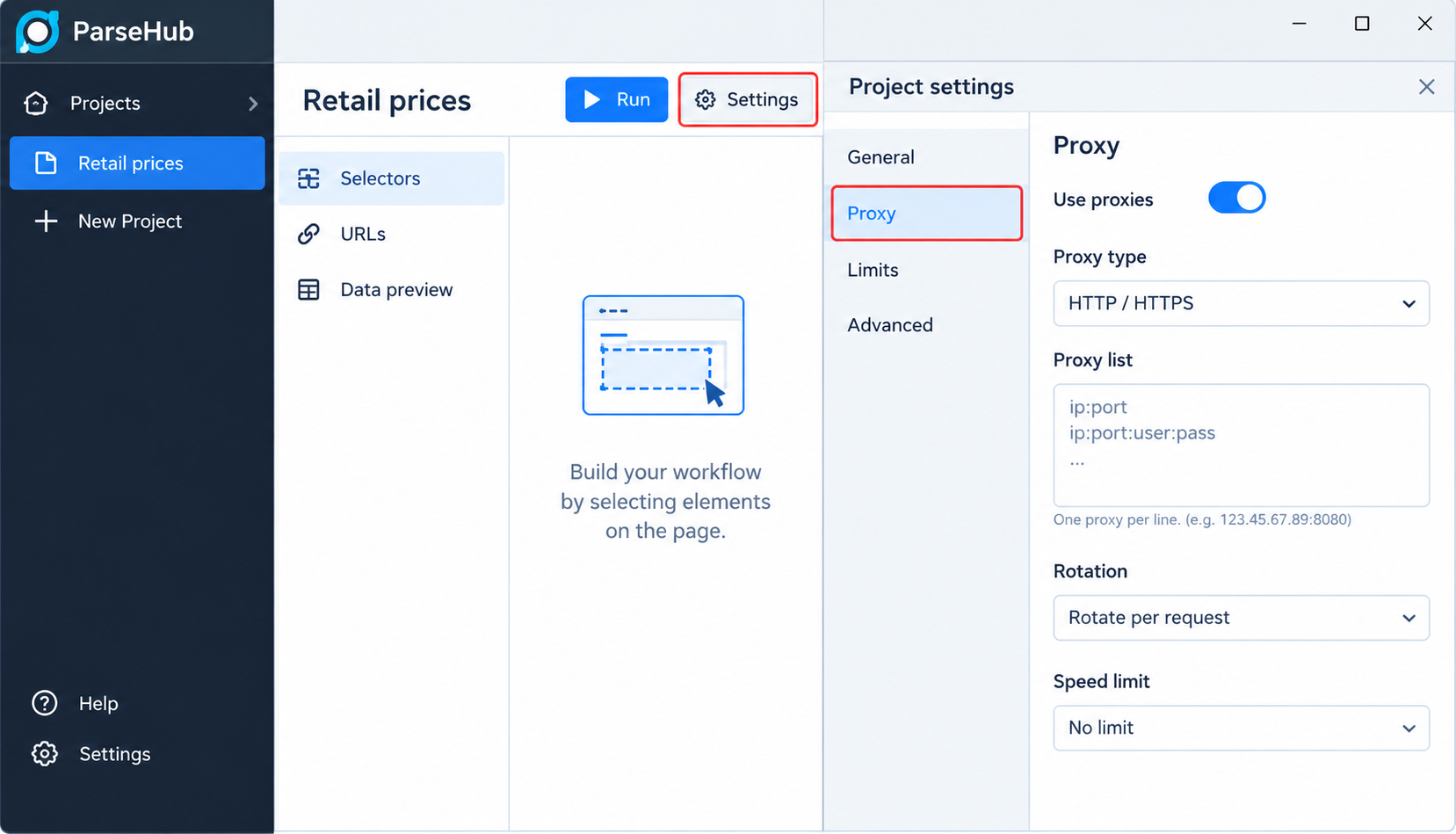
These choices are saved per crawl. Configure every scrape separately once before running it on the actual target website.
Step 2: Enable Custom Proxies and Paste Your List
For ParseHub proxy setup, use HTTP entries and enable the custom option in your project. ParseHub’s field accepts one IPAddress:Port:Username:Password entry per line.
- Enable Custom Proxies by opening the proxy panel, then click the toggle.
- Paste your list so each entry sits on its own line.
- Check the format and remove extra spaces, typos, and missing credentials.
- Click Save before running the project.
proxy1.example.com:8080:user1:pass1
proxy2.example.com:8080:user2:pass2
If one line lacks a password, the project may fail at the first request and produce empty datasets. Select a valid HTTP proxy before a full run, then check the first downloaded result for blank fields.
Step 3: Or Enable ParseHub's Built-In IP Rotation
If you do not have your own proxy list, use ParseHub's built-in IP rotation. It can rotate IP addresses from the app's pool and, where available, let you select a country.
This is simpler than a custom proxy setup but gives less control. It suits quick jobs on light protections. For example, a researcher scraping public US listings can enable rotation and choose United States. Check your plan, since some tiers omit these features. Use custom proxies when sites block datacenter-style addresses or require residential IPs.
How to Test Your ParseHub Proxy and Avoid "Proxy Error"
Skipping a short proxy test is the usual mistake. The credentials look valid, so a full crawl starts immediately. When the endpoint fails later, the run stops with empty data, and you must debug every setting again. Test the endpoint with a free online proxy checker before using it in ParseHub.
- Run a quick request against a single URL.
- Select an IP check page and extract the displayed IP address.
- Compare that value with your real network location.
- Click Run again, then click Download and confirm the data in CSV or JSON contains rows.
If ParseHub reports a proxy error during a test, inspect these causes first:
- Wrong format, such as missing host, port, username, or password fields.
- A plan limitation that keeps custom proxy entries disabled.
- Bad credentials or a blocked endpoint, sometimes shown as a 407 response.
For example, run one test on an IP-check page. If the returned address differs from your home network, the proxy works. If it matches, the request went direct, so re-check the entry.
Rotating, Sticky or Mobile: Which Proxy for Which Job
Match the proxy style to the target before you configure anything. Use IP rotation when you need to rotate between independent pages. Keep a sticky session when login state or multi-step navigation matters. Use a mobile proxy when strict websites distrust datacenter traffic.
- Rotating: Best for wide crawls. Each request can appear from a different source.
- Sticky: Keeps one address for the whole session. This protects account flows and nested pages.
- Mobile: This proxy type uses carrier IPs. For example, public profile pages on Facebook, LinkedIn, or Twitter may block datacenter and some residential ranges. A sticky mobile session can keep that multi-page run from being cut off.
The proxy features you choose depend on risk. Higher trust costs more and may run slower. A cheap datacenter proxy is fast, but weak reputation can end a crawl early. Residential IPs from real ISP lines sit between these extremes. For carrier-level trust, mobile proxies for ParseHub from OnlineProxy serve real 4G/5G carrier addresses through modems and SIM routers. They use HTTP with username and password, which fits the custom host:port:user:password field.
Fixing Common ParseHub Proxy Problems
- Run stops immediately: Check the custom proxy line for typos, missing ports, or wrong credentials. ParseHub needs the exact host:port:username:password order because one bad character can stop the request.
- Pages load, but data is empty: Test the page without the proxy. If data appears, select the fields again because JavaScript, Ajax, infinite scrolls, or a blocked UserAgent can change what ParseHub sees.
- Run is very slow: Switch to a nearer or less loaded proxy. Then test one page again before restarting the full job.
- Same IP keeps appearing: Enable rotation or add more proxies. A web scraping tool using one address is usually easy for target sites to detect and block.
Conclusion: Set Up, Test, Then Scale
ParseHub proxy setup succeeds when the address suits the target website and you verify data extraction before scaling. A small check prevents wasted runs and misleading empty results.
- Enable a custom proxy or built-in rotation in project settings.
- Choose an IP type that matches the site’s strictness.
- Run one test page before the full crawl.