- All proxies are mobile, clean, anonymous, and highly trustworthy.
- Mobile proxies can be used in any software; below you'll find the most popular ones.












How to Bypass CAPTCHAs With Cypress: Methods, Limitations, and Solutions
- Seo Za
- 5 minutes
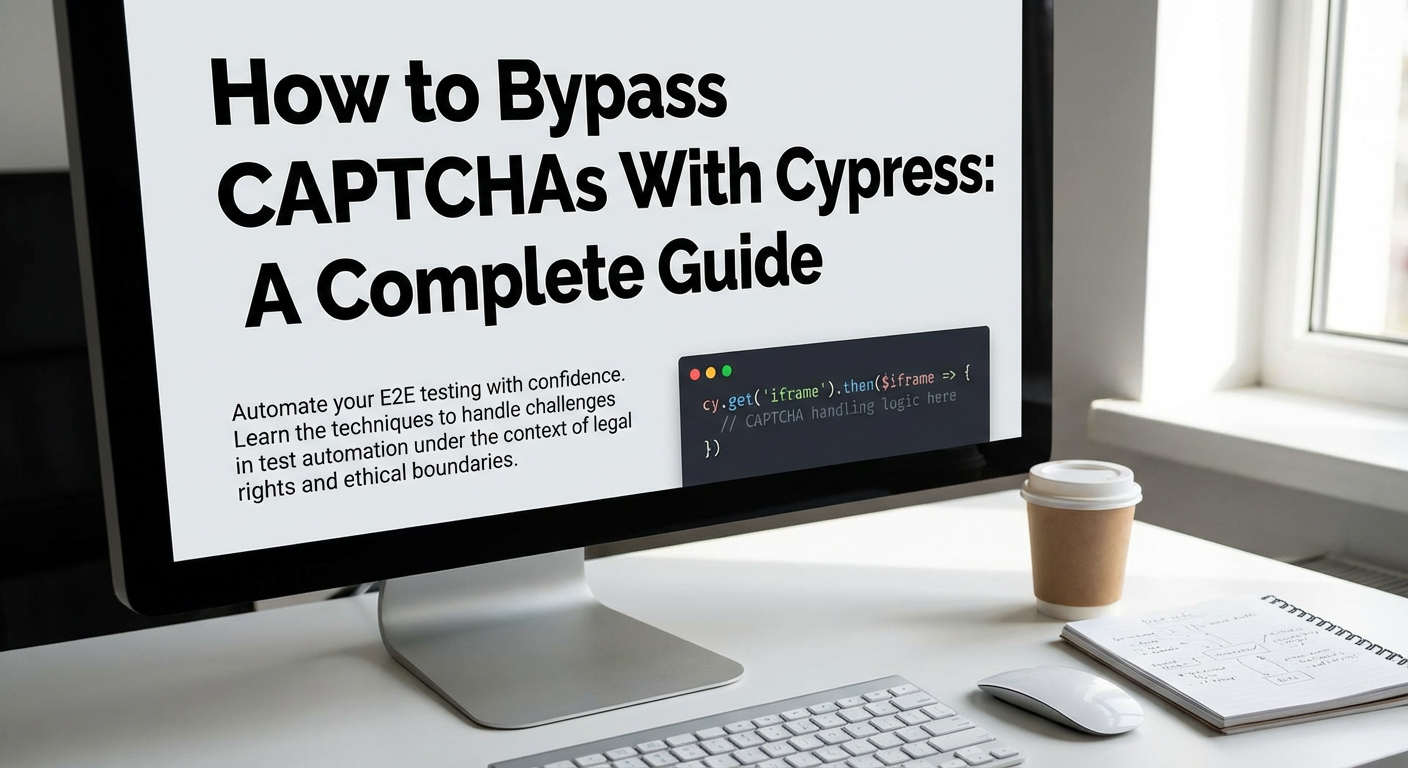
How to Bypass CAPTCHAs With Cypress: A Complete Guide
For software developers and quality assurance engineers who rely on Cypress for end-to-end testing, CAPTCHAs present a persistent challenge. These bot-detection mechanisms are designed to stop automated scripts, causing your tests to fail and undermining the reliability of your automation suite. This guide cuts through the complexity to show you exactly how to bypass CAPTCHAs with Cypress. We’ll cover why traditional manual workarounds fall short and how to implement a robust, production-ready solution using Mobile Proxies.
What Are CAPTCHAs and Why They Break Cypress Tests
CAPTCHAs (Completely Automated Public Turing tests to tell Computers and Humans Apart) are security measures designed for bot mitigation. They present a CAPTCHA challenge—like image selection or checkbox verification—to distinguish human users from automated scripts. This directly conflicts with Cypress automation, as the testing tool’s scripted interactions cannot solve these human-centric puzzles. The result is a test failure, breaking the execution flow and causing false negatives.
Type | Description | Typical Use Case | Automation Difficulty |
|---|---|---|---|
reCAPTCHA v2 ("I'm not a robot") | Checkbox that may trigger an image challenge if risk score is high. | High-security login forms, payment gateways. | Very High. Requires complex image recognition or third-party solving services. |
reCAPTCHA v3 | Invisible, returns a risk score (0.0-1.0) based on user behavior. | Continuous protection on high-traffic sites without user friction. | Extreme. Bypassing requires mimicking human behavior patterns to achieve a low score. |
hCaptcha | Similar to v2: checkbox leading to image/object classification tasks. | Alternative to reCAPTCHA, often used for privacy compliance. | Very High. Same fundamental barrier as v2, with different challenge datasets. |
An example of a broken test scenario:

When Cypress reaches this element, it cannot proceed, halting the test. This undermines automated testing goals by reducing test stability and coverage for any feature behind a bot detection layer.
Bypassing CAPTCHAs with Cypress: Manual Methods
Manual CAPTCHA bypass in Cypress relies on three primary techniques: test keys, iframe manipulation, and anti-detect browsers. Each offers a workaround but introduces significant fragility into test suites.
Using Test Keys to Disable CAPTCHA in Test Environments
Providers like Google publish reCAPTCHA test site keys that always return a passing score. Configure these in cypress.config.js or via CYPRESS_RECAPTCHA_SITE_KEY environment variables to disable CAPTCHA in tests. This works only in isolated test environments, not against live production services.
// cypress.config.jsmodule.exports = {
e2e: {
env: {      RECAPTCHA_SITE_KEY: '6LeIxAcTAAAAAJcZVRqyHh71UMIEGNQ_MXjiZKhI'    }  }}
Handling CAPTCHAs Inside Iframes with Cypress
CAPTCHA widgets often reside in cross-origin iframes, creating a Cypress iframe challenge. Use the cypress-iframe plugin to load the frame and interact with elements. This approach is brittle; any iframe attribute change breaks the selector.
import 'cypress-iframe';cy.frameLoaded('iframe[src*="recaptcha"]');cy.iframe().find('.recaptcha-checkbox').click();Leveraging Anti-Detect Features with Cypress
Anti-detect configurations modify browser fingerprints to avoid bot detection. You can configure Cypress launch options to inject stealth plugins or modify Chrome flags, attempting to appear as a real user. This requires frequent updates as detection algorithms evolve.
// cypress.config.jsmodule.exports = {
  e2e: {
   setupNodeEvents(on, config) {      on('before:browser:launch', (browser, launchOptions) => {        if (browser.family === 'chromium') {          // Strip the AutomationControlled flag to avoid easy detection          launchOptions.args.push('--disable-blink-features=AutomationControlled');          // Optionally load a stealth extension          // launchOptions.extensions.push('/path/to/stealth_extension');        }        return launchOptions;      });      return config;    }  }}
Method | Pros | Cons |
|---|---|---|
Test Keys | Simple, no cost, fully automated. | Only works in test environments; useless for staging with real CAPTCHA. |
Iframe Handling | Can interact with live CAPTCHA service. | Extremely fragile; fails on any DOM change or cross-origin policy update. |
Anti-Detect Browser | Higher success rate by mimicking human signals. | Complex setup, constant maintenance overhead. |
Why Bypassing CAPTCHAs with Cypress Manually Fails
Manual CAPTCHA bypass methods have severe drawbacks. Using test keys only works in test environments. Iframe manipulation is extremely fragile and breaks easily on minor updates. Anti-detect browser configurations are highly detectable over time and require heavy, constant maintenance.
This discrepancy causes frustrating false negatives—for example, a local test might pass, but the staging environment fails because a real CAPTCHA is triggered. Ultimately, these methods are unreliable and unscalable for production testing. Relying on them defeats the core purpose of automated testing.
The Root Cause: Why Do CAPTCHAs Trigger in Cypress?
To permanently fix the issue, we must understand why CAPTCHAs trigger in the first place. Modern CAPTCHAs, especially reCAPTCHA v3, evaluate network and user behavior to return a risk score from 0.0 to 1.0.
If your Cypress automation runs on CI/CD servers (like GitHub Actions, GitLab, or AWS), your scripts are operating from datacenter IP addresses. Security systems inherently distrust datacenter IPs, instantly flagging them as bot traffic and forcing a CAPTCHA challenge. You cannot solve a trust issue with an iframe hack.
The Ultimate Solution: Bypassing CAPTCHAs with Mobile Proxies
Instead of trying to solve the puzzle after it appears, you can prevent the puzzle from appearing at all. By routing your Cypress traffic through Mobile Proxies, you mask your automation framework behind the IP address of a real 4G/5G mobile network.
Due to Carrier-Grade NAT (CGNAT) architecture, a single mobile IP address is shared by thousands of real human users simultaneously. Anti-fraud algorithms cannot block or present hard challenges to these IPs without locking out legitimate mobile users. When your Cypress script uses a mobile proxy, the target website assigns it a high trust score, completely bypassing the CAPTCHA requirement.
- No third-party solvers needed: Tests run significantly faster because they don't pause to wait for an external service to solve image puzzles.
- Maximum Trust Score: Your traffic appears as organic mobile traffic, preventing reCAPTCHA v2/v3 and hCaptcha triggers.
- Minimal maintenance: There is no need to constantly maintain stealth extensions or fix broken iframe selectors.
Integrating Mobile Proxies into Cypress
Integrating a mobile proxy into your Cypress project is seamless. You don't need complex third-party SDKs; you simply configure the Cypress browser launch options to route its traffic through your mobile proxy node.
// cypress.config.jsmodule.exports = { e2e: { setupNodeEvents(on, config) { on('before:browser:launch', (browser, launchOptions) => { if (browser.family === 'chromium') { // Route Cypress browser traffic through your Mobile Proxy launchOptions.args.push('--proxy-server=http://your-mobile-proxy.com:port'); } return launchOptions; }); return config; } }};Pro Tip: To handle proxy authentication seamlessly in Cypress, you can use a local proxy forwarder or authenticate via browser extensions, ensuring your credentials remain secure.
Get Started with Reliable E2E Testing
CAPTCHAs cause persistent test failures, and manual bypass methods are fundamentally unreliable. Stop wasting time trying to solve CAPTCHAs or fixing brittle workarounds. Use Mobile Proxies to achieve reliable automation by preventing challenges from triggering seamlessly.